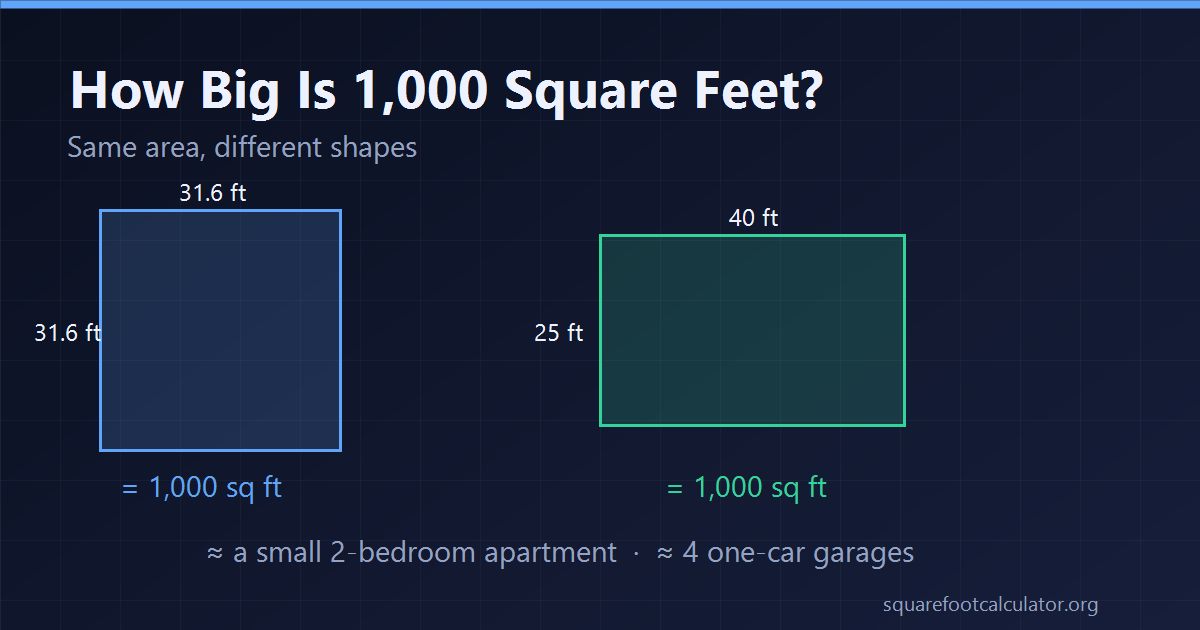
The difference between linear feet vs square feet comes down to dimensions: a linear foot measures length only (one dimension), while a square foot measures area, meaning length × width (two dimensions). Ten linear feet of baseboard is a 10-ft line; ten square feet of tile is a 10-ft² patch of floor. To convert between them you need the material's width: square feet = linear feet × width in feet. For the area side of any project, the free Square Foot Calculator measures rooms of any shape instantly.
Mixing these two units up is one of the most common and costly estimating mistakes in home projects, because stores price some materials by the linear foot and others by the square foot, sometimes on the same aisle. This guide draws the line clearly: what each unit means, which materials use which, how to convert in both directions with a full width chart, and how pricing differs so quotes stop being confusing.
One dimension vs. two
A linear foot (also called a lineal or running foot) is just an ordinary foot, 12 inches, measured along a line. The word "linear" adds no new math; it simply signals that you are only counting length and ignoring width. A 16-ft board is 16 linear feet whether it's 2 inches wide or 12.
A square foot is a unit of area, the space inside a 1 ft × 1 ft square. Area answers "how much surface?" rather than "how long?", which makes it the natural unit for anything that covers a plane: floors, walls, roofs, lawns.
The practical consequence: linear feet ignore width, square feet depend on it. That's the whole distinction, and it's why converting between them always requires one extra piece of information, namely how wide the material is.
Which unit does each material use?
The pattern is consistent once you see it: products made in long strips of a fixed width sell by the linear foot; products that cover variable areas sell by the square foot.
| Sold by the linear foot | Sold by the square foot |
|---|---|
| Lumber and boards | Flooring (hardwood, laminate, vinyl, tile) |
| Baseboard, crown molding, trim | Carpet (or per sq yd) |
| Fencing | Paint coverage |
| Gutters | Drywall |
| Countertops (at standard depth) | Roofing |
| Railings and handrails | Sod and landscaping fabric |
| Pipe, cable, conduit | Wallpaper coverage |
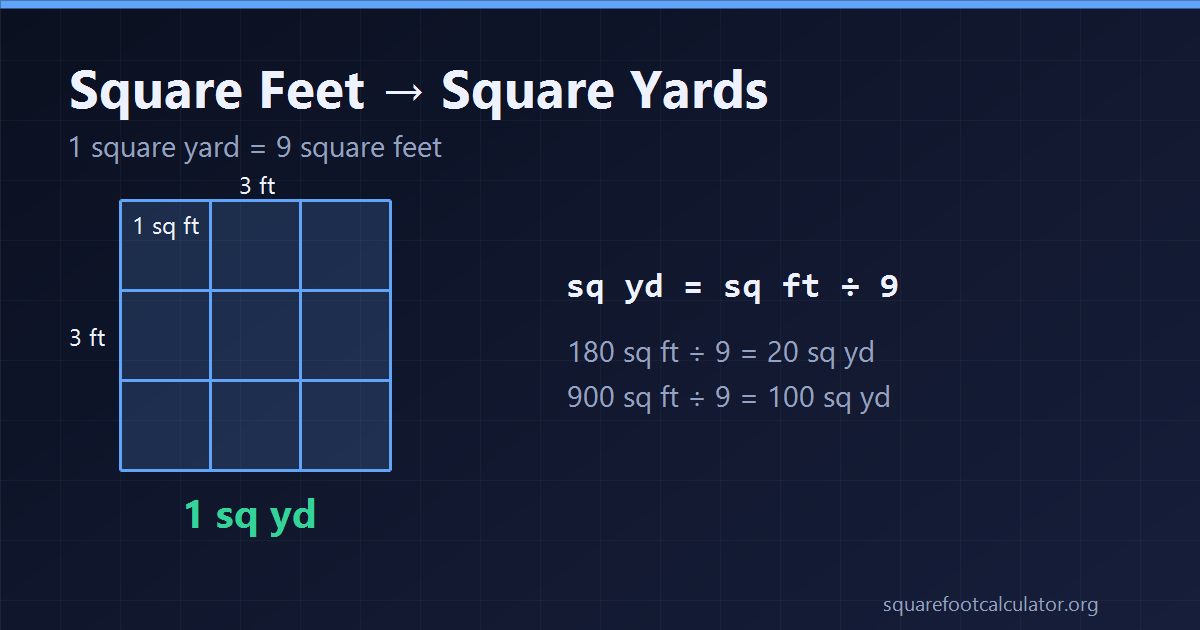
Why the split? A supplier selling 3½-inch baseboard doesn't need to talk about area. Every foot of it is identical, so length is the only variable and the only honest unit. Flooring is the opposite: rooms come in every size and shape, so the industry standardizes on area. (Carpet adds its own wrinkle by pricing per square yard; that conversion is covered in square feet to square yards.)
Countertops deserve a special note: fabricators quote "per linear foot" assuming a standard 25-inch depth. The width is baked into the price rather than absent, which is why an island deeper than 25 inches gets re-quoted by area or with an upcharge.
Converting linear feet to square feet
Square feet = linear feet × width in feet
The only trap is that material widths are stated in inches, so divide by 12 first. Here is what 100 linear feet covers at common material widths:
| Material width | Width in feet | 100 linear ft = |
|---|---|---|
| 3" (narrow plank, trim) | 0.25 | 25 sq ft |
| 4" | 0.333 | 33.3 sq ft |
| 5" (common LVP/hardwood) | 0.417 | 41.7 sq ft |
| 6" (deck board nominal) | 0.5 | 50 sq ft |
| 8" | 0.667 | 66.7 sq ft |
| 12" | 1.0 | 100 sq ft |
| 24" | 2.0 | 200 sq ft |
| 36" (3-ft roll) | 3.0 | 300 sq ft |
| 48" (4-ft roll/sheet) | 4.0 | 400 sq ft |
And in reverse, the direction flooring estimates actually run:
Linear feet = square feet ÷ width in feet
Try it: get your room's exact area with the Square Foot Calculator, then divide by your plank or roll width to know how many linear feet to buy.
Worked examples
Example 1: Flooring planks. Your living room is 250 sq ft (measure it with the Flooring Calculator) and you've chosen 5-inch-wide planks. Width in feet: 5 ÷ 12 = 0.417. Linear feet needed: 250 ÷ 0.417 ≈ 600 linear ft of plank, before waste. At the standard 10% waste factor, buy coverage for 275 sq ft.
Example 2: Baseboard for a room. Trim is a pure linear measurement: walk the perimeter. A 12 × 14 ft room has a perimeter of 2 × (12 + 14) = 52 linear ft; subtract a 3-ft doorway and you need 49 linear ft of baseboard. Note that the room's area (168 sq ft) never enters the calculation. This is the clearest illustration of the difference. For perimeter math with feet-and-inches measurements, the Feet and Inches Calculator keeps the arithmetic clean.
Example 3: Deck boards. A 200 sq ft deck uses 5/4 × 6 boards with an actual face width of 5.5 inches (0.458 ft). Linear feet: 200 ÷ 0.458 ≈ 436 linear ft; add 10% waste ≈ 480 linear ft, which is sixty 8-ft boards.
Example 4: Fencing, both units at once. A fence line runs 150 linear ft. That's how the fence company quotes it. But if you're staining that fence, you need area: 150 ln ft × 6 ft tall = 900 sq ft per side, or 1,800 sq ft for both faces. Same fence, two units, depending on the question you're asking.
Example 5: Countertop quote check. A kitchen has 18 linear ft of counter at the standard 25-inch depth. Area: 18 × (25 ÷ 12) = 18 × 2.083 = 37.5 sq ft. If one fabricator quotes $75 per linear foot and another quotes $36 per square foot, convert to compare: $75/ln ft ÷ 2.083 sq ft = $36/sq ft. Identical pricing, different units.
How to measure each one correctly
Measuring linear feet is a single-direction job: run the tape along the path the material will follow and total the segments.
- For trim, measure each wall at the floor line, add the segments, and subtract door openings.
- For fencing, measure the property line run by run; corners just end one run and start another.
- Round each segment up to the next foot before totaling. Strip goods sell in fixed lengths (8, 10, 12, 16 ft), and short pieces with a splice look worse than a little offcut.
- Mixed feet-and-inches measurements (12' 7" + 9' 4" and so on) are where errors creep in; the Feet and Inches Calculator adds them without decimal slips.
Measuring square feet always takes two directions: length × width per rectangle, odd shapes broken into rectangles and triangles, everything summed. The main Square Foot Calculator covers every common shape, including circles and L-shapes, if the geometry gets awkward.
A good habit for any project: write the unit next to every number as you measure. A bare "52" on a notepad reads as square feet an hour later when it was actually a perimeter, and that's exactly how someone tiles a hallway with a quarter of the material they need.
Why pricing uses different units (and how to compare)
Per-linear-foot pricing exists because width is fixed by the product. A mill selling 1×6 pine doesn't price by area, since you can't buy half the width, so the linear foot is the natural billing unit. Per-square-foot pricing exists where the buyer's area is the variable: nobody sells "a living room's worth" of tile.
Two rules keep quotes comparable:
- Convert everything to cost per square foot before comparing. Divide a linear-foot price by the material width in feet. Trim at $2.40/ln ft for a 3-inch profile is effectively $9.60 per square foot of coverage, which sounds high until you remember you're buying its milled shape, not coverage.
- Watch for unit switches inside one quote. A flooring bid may list material per square foot but stair nosing, transitions, and quarter-round per linear foot. Both are legitimate; just total them separately.
Roll goods are the hybrid case. Wallpaper, landscape fabric, and upholstery fabric are sold by length (a roll, or a linear yard cut from one) but used by area. The roll's fixed width bridges the two. A 3-ft-wide × 50-ft landscape fabric roll covers 3 × 50 = 150 sq ft; a linear yard of 54-inch fabric is 3 × 4.5 = 13.5 sq ft. Whenever a product is priced by length, find its width and you can always recover the coverage.
Board feet, for the curious, are a third thing entirely: a volume unit for rough lumber (1 board foot = 144 cubic inches, a 12" × 12" × 1" slab). Linear, square, and board feet measure one, two, and three dimensions respectively, and hardwood dealers really do use all three.
When to use linear feet and when to use square feet
Use linear feet when:
- Measuring along a line: walls for trim, fence runs, gutter length, pipe or cable runs
- Buying strip goods of fixed width: lumber, molding, railing, countertop runs
- The question is "how long?"
Use square feet when:
- Measuring surfaces to cover: floors, walls to paint, roofs, lawns
- Buying coverage goods: flooring, tile, drywall, sod, paint
- The question is "how much surface?"
At-a-glance comparison
| Linear foot | Square foot | |
|---|---|---|
| Dimensions | 1 (length) | 2 (length × width) |
| Measures | Distance along a line | Surface area |
| Formula | Just the length | Length × width |
| Typical tools | Tape measure along an edge | Tape measure both directions + multiplication |
| Typical materials | Lumber, trim, fencing, gutters | Flooring, paint, tile, roofing |
| Convert | × width (ft) = sq ft | ÷ width (ft) = linear ft |
The takeaway
Linear feet measure length; square feet measure area. The bridge between them is always the material's width: linear ft × width (ft) = sq ft, and sq ft ÷ width to go back. Measure perimeters in linear feet for trim and fencing, measure surfaces in square feet for flooring and paint, and convert prices to a common unit before comparing quotes. When it's time for real numbers, get your room's exact area from the free Square Foot Calculator and plan materials with the Flooring Calculator.
Frequently Asked Questions
How many square feet is 1 linear foot?
There's no fixed answer; it depends on width. One linear foot of 6-inch-wide board covers 0.5 sq ft; one linear foot of 4-ft-wide roll covers 4 sq ft. Multiply the length by the width in feet.
How do I convert linear feet to square feet?
Multiply linear feet by the material's width in feet (inches ÷ 12). Example: 300 linear ft of 5-inch plank = 300 × 0.417 ≈ 125 sq ft.
Is a linear foot the same as a regular foot?
Yes. Both are 12 inches. "Linear" just clarifies that you're measuring length only, not area, in contexts where both units appear.
Why is lumber priced by the linear foot instead of the square foot?
Because a board's width is fixed at the mill, length is the only variable the buyer chooses. Area pricing only makes sense when the buyer's coverage area varies, as with flooring or tile.
How many linear feet do I need for 500 square feet of flooring?
Divide by the plank width in feet. With 5-inch planks (0.417 ft): 500 ÷ 0.417 ≈ 1,200 linear ft. Add about 10% for cutting waste.
Ready to run your own numbers?
Get the exact area of any room shape, then convert to the units your project needs.